
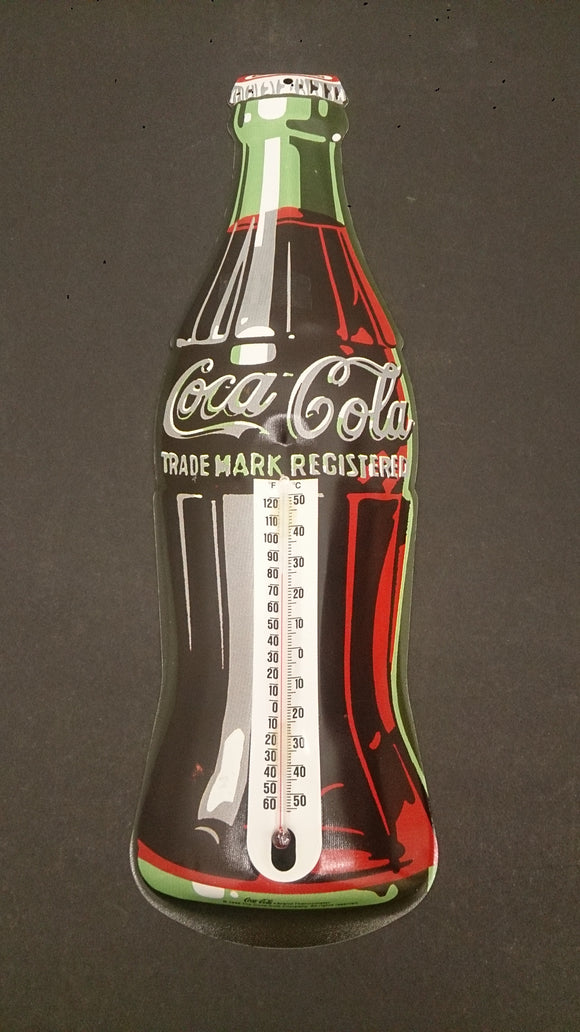


Coca-Cola Advertising, Wall Barometer, Metal Sign, Repro.
Coca-Cola Advertising, Wall Barometer, Metal Sign, Repro.
Coca-Cola's history began in 1886 when the curiosity of an Atlanta pharmacist, Dr. John S. Pemberton, led him to create a distinctive tasting soft drink that could be sold at soda fountains. He made a flavoured syrup and took it to his neighbourhood pharmacy, where it was mixed with carbonated water and deemed “excellent” by those who sampled it. Dr. Pemberton’s partner and bookkeeper, Frank M. Robinson, is credited with naming the beverage “Coca‑Cola” as well as designing the trademarked, distinct script, still used today.
Did you know? The first servings of Coca‑Cola were sold for 5 cents per glass. During the first year, sales averaged a modest nine servings per day in Atlanta. Today, daily servings of Coca-Cola Beverages are estimated at 1.9 billion globally.
Prior to his death in 1888, just two years after creating what was to become the world’s #1-selling sparkling beverage, Dr. Pemberton sold portions of his business to various parties, with the majority of the interest sold to Atlanta businessman, Asa G. Candler. Under Mr. Candler’s leadership, the distribution of Coca‑Cola expanded to soda fountains beyond Atlanta. In 1894, impressed by the growing demand for Coca‑Cola and the desire to make the beverage portable, Joseph Biedenharn installed bottling machinery in the rear of his Mississippi soda fountain, becoming the first to put Coca‑Cola in bottles. Large-scale bottling was made possible just five years later, when in 1899, three enterprising businessmen in Chattanooga, Tennessee secured exclusive rights to bottle and sell Coca‑Cola. The three entrepreneurs purchased the bottling rights from Asa Candler for just $1. Benjamin Thomas, Joseph Whitehead, and John Lupton developed what became the Coca‑Cola worldwide bottling system.
Among the biggest challenges for early bottlers, were imitations of the beverage by competitors coupled with a lack of packaging consistency among the 1,000 bottling plants at the time. The bottlers agreed that a distinctive beverage needed a standard and distinctive bottle, and in 1916, the bottlers approved the unique contour bottle. The new Coca‑Cola bottle was so distinctive it could be recognized in the dark and it effectively set the brand apart from the competition. The contoured Coca‑Cola bottle was trademarked in 1977. Over the years, the Coca‑Cola bottle has been the inspiration for artists across the globe — a sampling of which can be viewed at the World of Coca‑Cola in Atlanta.
The first marketing efforts in Coca-Cola's history were executed through coupons promoting free samples of the beverage. Considered an innovative tactic back in 1887, couponing was followed by newspaper advertising and the distribution of promotional items bearing the Coca‑Cola script to participating pharmacies.
Fast forward to the 1970s when Coca‑Cola’s advertising started to reflect a brand connected with fun, friends and good times. Many fondly remember the 1971 Hilltop Singers performing “I’d Like to Buy the World a Coke”, or the 1979 “Have a Coke and a Smile” commercial featuring a young fan giving Pittsburgh Steeler, “Mean Joe Greene”, a refreshing bottle of Coca‑Cola. You can enjoy these and many more advertising campaigns from around the world in the Perfect Pauses Theater at the World of Coca‑Cola.
Item Code - SIG17B206OAC
Width: 5" Height: 16 1/2" Depth: 7/8" Weight: 180 g